| By
/ March 18, 2005 04:08 AM |

|
PoliBlog has a piece where he dismisses farm subsidies as a waste of money and that farms should be allowed to die if they aren't profitable. Spurred by this recent article where the U.S. Secretary of Agriculture talked of cuts to the subsidies to reduce the deficit, I'll throw my hat in the ring.
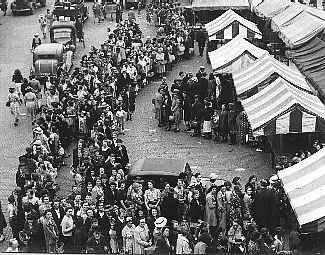 | Northampton Market Square
Food Queue For English Tomatoes In WWII |
This is one case where I see government spending as a boon. The less than 1% of our federal budget we spend on farm subsidies is a very cheap insurance policy against what happened to Britain in World War II. With the English relying on imports for their food to feed their population, they were reduced to near starvation and massive rationing when the external sources were cut off.
This is really not an economic issue, but more of a homeland security issue. If we allow enough farms to go out of business that we can't adequately feed our population in the case of some world changing event, we are going to have some serious problems. I personally don't look forward to food rationing or being robbed for my can of peas by groups of starving thugs because we didn't want to spend the money necessary to keep a decent supply of our own.
Another bone of contention I have with it is that it can be used as an extortion tool. Tariffs can be manipulated by other countries or demanded eliminated in other industries by threat of "raising our food costs". By giving this industry to foreign interests we are really setting ourselves up for some serious risk in the future.
As most know I'm a Conservative, but in this case I have to side with a government supported industry because the reward of being prepared far outweighs the risks.
Now it's your turn. Tell me where I'm wrong.

This entry is in the following archive(s):
Next and Previous Entries:
Posted by Digger on March 18, 2005 04:08 AM (Permalink)
Well, for one thing you are assuming that without the subsidies we would have a significant diminishment of the food supply, yet that would not be the case.
Second, cutting off subsidies would hardly result in a shift in our source of food. It isn't as if agribusiness in the US is so dependent on subsidies that they would all fold up if the federal money stopped flowing.
Third, England is a tiny island, the US is a huge territory with mucho land for cultivation and production. It simply isn't comparable (not to mention that our abiity to produce food has increased radically since WWII in general).
Really: it is an unnecessary intrusion into the market and a waste of tax dollars.
Posted by: Steven Taylor on March 18, 2005 05:34 AM
Unlike Oil as an example, you can't "turn it on". If you let farmland go fallow it take a long time for it to be back up and running.
Posted by: Digger on March 18, 2005 06:45 AM
Perhaps so, although it is easier to produce food in such circumstances than to make oil appear by magic.
Regardless, that doesn't address the other issues, which are more substantive anyway...
Posted by: Steven Taylor on March 18, 2005 06:56 AM
The problem with your argument is that you are presupposing an utterly unforeseen change in the international system coupled with a radical diminution of food production in the US prior to that cataclysm and using an island nation with 1940s technology as the basis for comparison.
Posted by: Steven Taylor on March 18, 2005 07:03 AM
You both have good arugments, but I believe there's a hidden issue here.
Part of the reason farmers are being squeezed out of business is companies like ConAgra. These giant food companies have been slowly, quietly and surely taking over privately owned farms for years through the use of "Eminent Domain" laws. At the same time, they've negotiated back-door water rights deals that put private farmers and even entire cities at their mercy. With these acquisitions, they get to set the price of both water supplies as well as agricultural products.
From where I sit, removing these farm subsidies from private farmers will only allow these big companies to come in, take the land and create a monopoly market hidden from public view. Not to mention the expansion of genetically modified food products.
David Eccles
Posted by: deccles on March 18, 2005 10:10 AM
As far as my use of England it was a simple example of the dangers involved with not having the ability for self preservation.
While I agree with some of your arguments Steven, I still feel there needs to be farm subsidies.
In the inerests of full disclosure I have no ties to the farm industry, nor have I ever been a farmer. So my interests are not of a personally beneficial nature other than being able to buy a tomatoe if our shipping industry or food distribution network is disrupted.
There is no excuse not to be prepared within reason and 1% is a small amount I'm willing to pay for that security.
Posted by: Digger on March 19, 2005 01:56 AM
First, you can't say "it only costs 1% of the federal budget". There are infinite unseen consequences; the costs are much greater than the immediate numbers. For example, if subsidies eliminate or harm foreign competition, then there is reduced global economy, resulting in less overall production and quality of life. And American resources could be dedicated to more favorable products for consumers, creating greater income, and thus a greater federal budget.
That's not the real problem, though. Subsidies sacrifice progress and efficiency of markets. Consider the US automobile industry. At first, the subsidy aids the domestic industry. Over time, however, our production becomes noticeably inefficient compared to the rest of the world. By protecting any industry from competition, it necessarily makes it less productive over time than it would have been absent the subsidy. This would create greater demand for imported food, which sees lower and lower prices. You would need larger and larger subsidies or outright embargoes to stop it.
In other words, one could argue the direct opposite of your argument - the absence of subsidies is necessary to be able to produce enough food domestically to survive a severe and cataclysmic trade breakdown.
Finally, look at what is actually being subsidized. Most of the items aren't the staple foods we most enjoy, such as chicken and beef. This proves the point that they are unnecessary.
And furthermore, the morons in DC are subsidizing people like Ted Turner and D Rockefeller to the tune of $200k + for simply not farming their land. The rationale is that if they did, it would "hurt" other producers. These kind of fanciful stretches of logic are common in DC, so why approve of ANYTHING they do?
As far as Britain, what if there were more Brits to feed than their domestic farmland realistically allows? A subsidy cannot change this. It would simply lead to prolonged inefficiency, and when the trade breakdown occurred, we'd still find the starvation we tried to avoid. absolute insurance would be complete prohibition of all food imports, so that the population never got to that point.
A better government policy is non-intervention, erring on the side of peace, and global free market capitalism.
Posted by: bob on January 12, 2009 02:20 PM
|